
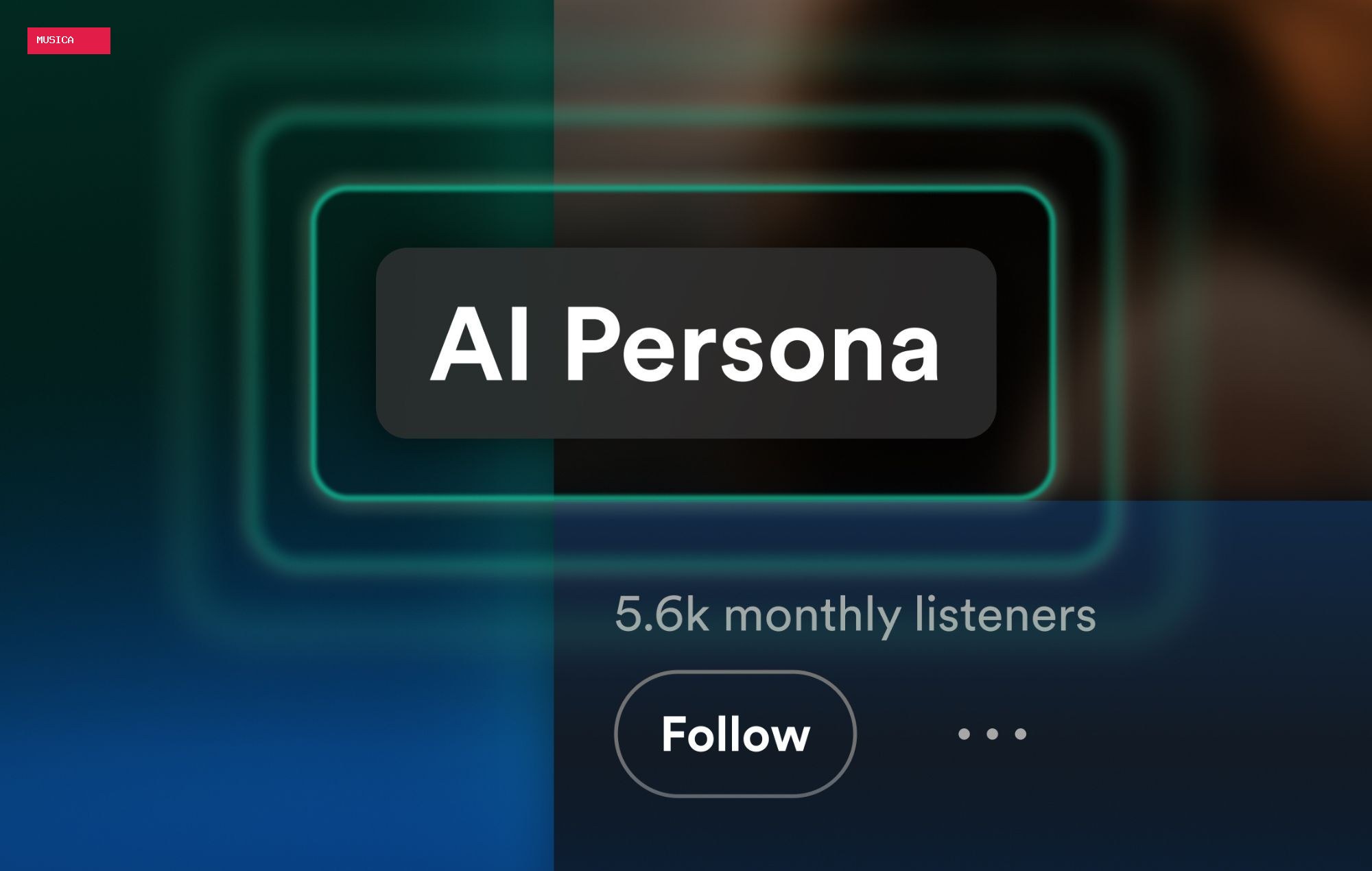
Spotify has announced that it will be introducing a new labelling system, so that users can quickly identify artists and content generated by AI.
READ MORE: In the age of AI Oasis, there’s no point being ordinary.
The move comes as there has been a significant rise in AI-generated music available online in recent years. Just last month, Deezer shared that AI-generated music now surpasses 50 per cent of daily uploads on the platform – the first time that human-made music has been outnumbered by AI alternatives – and before then it was found that 97 per cent of people “can’t tell the difference” between real and AI music.
Now, Spotify is looking to increase transparency on the platform by introducing badges to help label AI-generated content and the pages of AI-generated artists.
From mid-September, an “AI Persona” badge will be added to some profiles so that listeners can quickly distinguish between human artists and AI-generated platforms posing as a human being.
The badge will be prominent on their profile, as well as in the search results and on the track rows across playlists.
Spotify is rolling out the ability to label artists as being an ‘AI Persona.’.
The label can only be applied by creators themselves or by Spotify if they detect an artist to be AI-generated. Artists labelled as an AI Persona will be excluded from personalised recommendations.
Pop Base (@PopBase) August 11, 2026.
As well as that, Spotify will ensure that no music from AI Personas are included in any editorial or algorithmic recommendations, unless the user already follows some AI personas.
From today (Wednesday August 12), artists can disclose whether their profile represents an AI Persona through Spotify for Artists. The streaming platform is hoping that artists will be transparent, however it will also be carrying out a review to find any remaining pages that did not self-disclose.
Later this year, listeners will also be able to report artist profiles that they suspect represent AI personas. The reports will be sent to the review team from there.
It’s worth highlighting that the latest changes to Spotify look to identify and label whether or not a profile represents an actual human – not to identify how music was made, as human artists may be using AI to make music too.
Spotify AI profile recognition design. CREDIT: Spotify.
For information about how songs were made, Spotify has already introduced Verified By Spotify which signals that an artists is a real human, AI Credits which allow artists to disclose to listeners how they used AI in their music creation, and SongDNA which gives listeners deeper context on the artists and contributors behind a track.
There are also Artist Details to show quick snapshot of an artist’s authentic activity on Spotify, and Artist Profile Protection which allows creators to review and approve their releases, preventing listener confusion about misattributed music.
The latest changes come following Spotify confirming that it was removing 75million “spammy tracks” and targeting impersonators last September.
Other platforms cracking down on AI music include Apple Music, which is also labelling music generated by artificial intelligence, and TIDAL, which confirmed that it will not be paying royalties to any music made entirely by artificial intelligence.
Deezer has tried to combat the rise in music made entirely by artificial intelligence too, launching a tool to detect AI-generated music on playlists from 20 different streaming platforms.
At the start of the year, Bandcamp revealed that it had banned all music made with AI, and SoundCloud clarified its stance on AI after a wave of backlash from users.
While Spotify is helping label AI profiles and remove AI spam on the platform, in May it also announced that it has signed a new deal with Universal Music Group (UMG) that will allow fans to reimagine songs with AI.
Lorde recently hit out at a new AI-generated feature on Spotify, saying that the public “don’t want this”. She joins a growing number of artists who have been speaking out against AI.
Jack Antonoff, who called AI music creators “godless whores”, and SZA, who spoke out after discovering that over 200 of her tracks had been used to train AI software.
Smashing Pumpkins frontman Billy Corgan also described using AI assistance to write music as “a deal with the devil”, and in 2025 Damon Albarn, Kate Bush and Annie Lennox joined over 1,000 artists in releasing the silent album ‘Is This What We Want?’ in opposition to the rise of AI in the music industry.
This Is Lorelei was only meant to be a side project. It’s made Nate Amos an indie darling.
Nate Sib is finding peace and purpose in his pop mission.
?Tony’ review: a mostly delicious taste of pre-fame Anthony Bourdain.
The cursed story of ‘The Wicker Man’ has a new tragic chapter.
Ravyn Lenae – ‘Blue Island’ review: R&B’s wunderkind finds her new pop groove.
?Black Myth: Wukong’ sequel will be inspired by ‘The Odyssey’.
AI slop film channel ridiculed for being “devoid of sauce and creativity”.
Brad Pitt latest A-lister to back AI use in Hollywood: “It’s going to help films get made”.
Boy George hits out at “bunch of c***s” Bandcamp for removing pro-Israel song.
Fontes
Informação baseada em material público de NME, reescrito pela redação ULTRA NOTÍCIAS.