

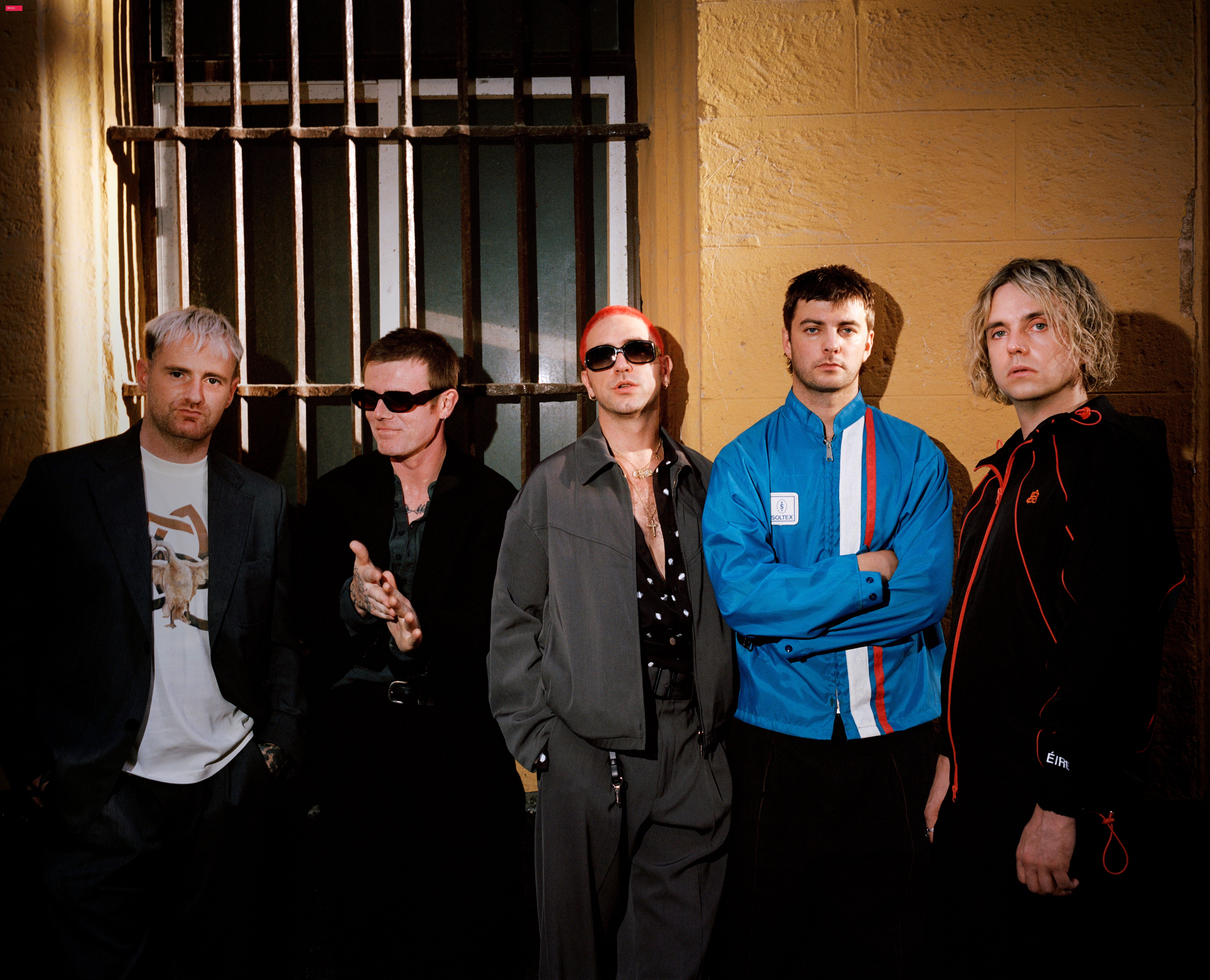
Fontaines D. C. continue their evolution from underground rock insurgents to arena-baiting anthem merchants on their Romance follow-up. Lead single “Marianne” infuses sleazy synth-pop with the air of a haunted lullaby, while—in a pairing that makes more sense than it should—the Irish band unites with fellow crossover sensation Rosalía on “Where Is Gone?” The psychedelic blurring of genre boundaries plays off the titular concept, which, says Grian Chatten in press materials, describes the environment of the album itself.
Fontaines D. C.: Câmara de Dopamina [XL].
Listen on Apple MusicListen on SpotifyListen on TidalListen on Amazon MusicListen/Buy at BandcampBuy at Rough Trade.
The Avalanches: No Bad Memories [Modular].
Os que nós, acima de certa idade, todos temos aquele jingle — uma música corporativa gravada em nossa memória como uma pintura em Lascaux. (Meu? Education Connection.
The original Big Mac theme.) Leave it to the Avalanches, masters of making up for lost time, to run with this phenomenon. The duo’s first proper LP since the pandemic draws inspiration from lost jingles and now-defunct technology like those two buddies pictured above.
The features across the 31-song project bring a similar “old becomes new again” spirit to the group’s anhedonia-flecked electronica, uniting legends such as Yellow Magic Orchestra cofounder Haruomi Hosono with fresher-faced experimentalists Portraits of Tracy.
Rachel Chinouriri: Acho que Falei Muito Cedo [Parlophone].
On the follow-up to her 2024 debut, What a Devastating Turn of Events, Rachel Chinouriri makes a home in the mirror-polished smear between Y2K pop and the slick UK indie that surfaced in its wake.
Ela pré-visualizou o LP com o rush de açúcar synth-pop “One Song Away From Crying” e seu contraparte mais escura “Make Believe”, que trata de “allowing someone who clearly hates me to have access to me at any moment”, escreveu em uma declaração.
Recent tour support slots with Gracie Abrams and Florence + The Machine hint at where the Londoner has her compass set.
Sophia Stel: O Maior Álbum de Todos os Tempos [A24].
The Greatest Album of All Time, Sophia Stel’s first album for A24’s nascent label, is an appropriately cinematic survey of life during an ascendant career moment: bigger crowds, new hangers-on, and long stretches on the road far from home.
To hold on to some semblance of consistency, the Canadian singer-songwriter-producer kept her set-up similar to the DIY home studio where she made her 2025 EP, How to Win at Solitaire.
Ainda assim, esses toques de dance‑pop melancólicos e reflexivos representam um grande salto: lembram que o grande pop se reduz a uma ciência, e o Autotune bem empregado é uma forma de arte em si.
Na minha mente, o produtor de Montreal Jacques Greene sempre foi um produtor after‑hours, alguém cuja música de dança reflexiva, com influências de R&B, se encaixa em um aconchegante living room às 5h da manhã.
more than an actual dancefloor. With the first bass drop of JG, listeners will immediately sense this album is different. On his first solo LP in seven years, Greene’s crystalline melodies and poppy vocals find a perfect marriage with 2-step, dubstep, and deep, deep basslines.
They Are Gutting a Body of Water: Kool Faith / Loosies II [ATO/Julia’s War].
They Are Gutting a Body of Water’s Doug Dulgarian still has fond memories of the jewel-cased mixtapes he’d pick up on the cheap as a kid, and the expansive yet hyper-regional feel of a genre-spanning track list spliced together by a local radio DJ.
O novo mixtape do TAGABOW dá à banda de Filadélfia o seu próprio momento de DJ, compilando faixas com uma variedade de colegas do selo Julia’s War e amigos, incluindo Spirit of the Beehive, Greg Mendez, Hotline TNT, DJ Manny, Lucy (Cooper B.
Handy), and RXKNephew. “The word mixtape initially meant a homespun tape that you typically listened to yourself or gave to somebody else,” Dulgarian explained in press materials.
Dummy: Do You Love the Color of the Sky? [Polyvinyl].
Embora Dummy faça piada de que “making music shouldn’t be fun” nos materiais de imprensa para seu novo álbum, o quinteto de Los Angeles infunde júbilo fácil em “Do You Love the Color of the Sky?”.
Newly incorporating breakbeats into their bread and butter of ambient shoegaze and chamber-leaning electronic pop, the band tackles thorny social topics like the surveillance state and government overreach, carefully guided by vocalist Emma Maatman’s unmistakeable lilt.
Worldpeace DMT: Stick Around for Tea [WPDMT].
Em um ano de grande sucesso para o campo nascente do “laptop twee”, a banda britânica Worldpeace DMT se destacou por sua bricolagem afiada, porém sincera, de mid-2000s indie, jangly vintage pop e, de forma bem-humorada e irônica, New York downtown worship.
Leo Fincham and Rowan Miles (who splits time between this band and her more post-hyperpop-minded duo the Femcels) keep the momentum up on the charming Stick Around for Tea.
Following in the ersatz footsteps of Belle & Sebastian and their Pacific Northwest brethren at K Records, they’ve filled out their sound with more layers and lusher production without sanding down the peculiarities that make them great.
Geólogo e Kyle Simon: As Sereias [Fora do Tempo].
The origin story behind The Sirens sounds like the wishful thinking of a sci-fi obsessive-turned-conspiracist. Animal Collective’s Geologist conceived the album at the Joshua Tree observatory of visual artist Kyle Simon, harnessing the power of the moon to record music.
Simon rotated a telescope towards the night sky while photodiodes detected light from planets and stars—which was then converted into an electrical signal with an analog amplifier.
O geólogo passou isso pelo seu equipamento modular de sintetizador como voltagem de controle; ao mudar o tom, o filtro e o ritmo, ele ouviu a natureza em tempo real como se estivesse ativamente entre as estrelas.
Heavens to Betsy: Baby’s Gone [Kill Rock Stars].
Heavens to Betsy—the pre-Sleater-Kinney duo of Corin Tucker and the Husbands’ Tracy Sawyer—haven’t released an album since 1994, but their comeback LP, Baby’s Gone, has been even longer in the making.
The record brings together 16 tracks from multiple releases: a long-lost demo the pair recorded in 1992, the following year’s These Monsters Are Real, and 1994’s Direction 7” recordings.
Older and wiser but as full of conviction as they were all those decades ago, Heavens to Betsy remind us that righteous feminist fury never loses its relevance or power.




Comentários
Participe da conversa. Comentários passam por moderação antes de aparecer.
Carregando comentários…